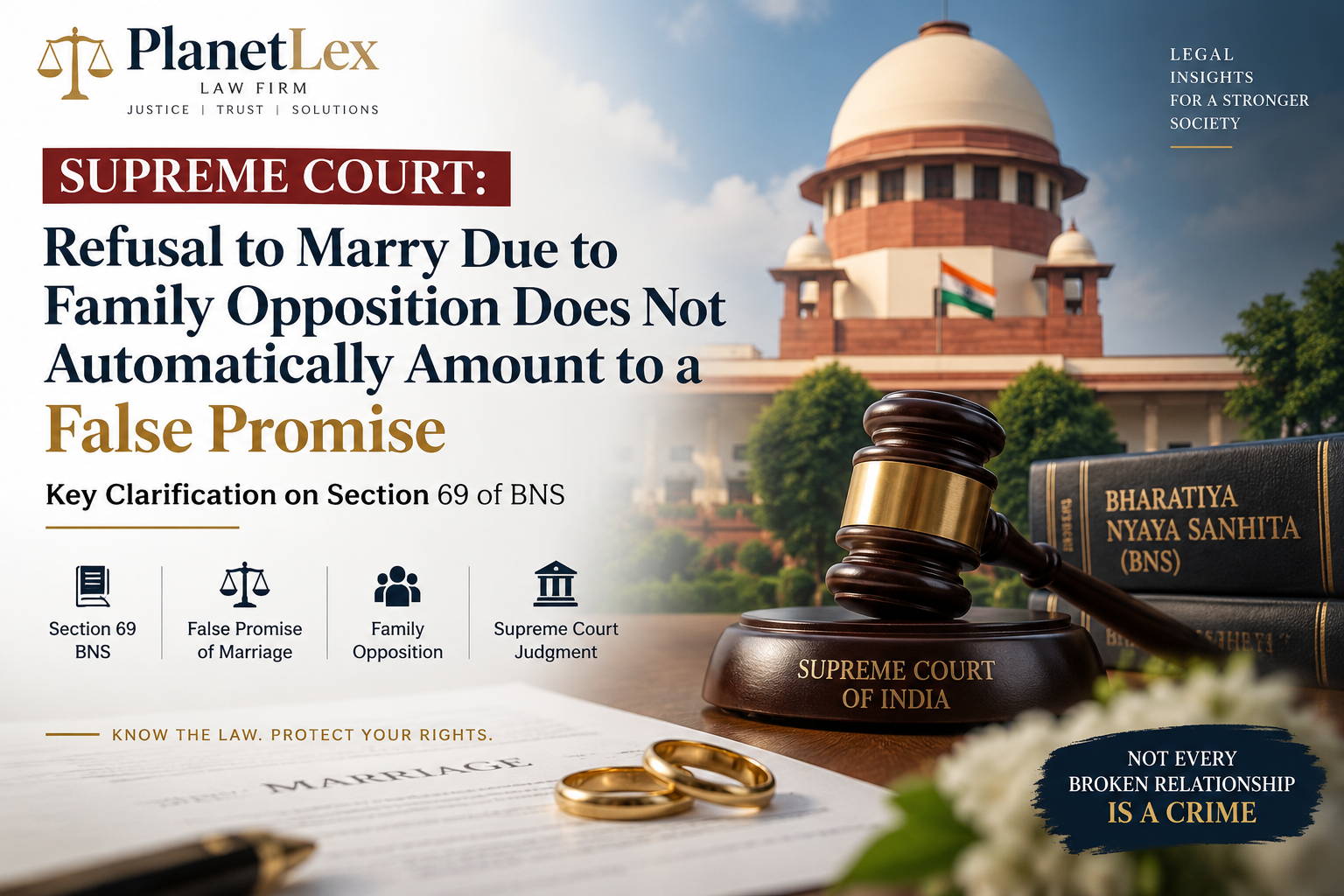
Supreme Court: Refusal to Marry Due to Family Opposition Does Not Automatically Amount to a False Promise
Advocate Anurag Arora
Advocate, PlanetLex Law Firm
(Legal Awareness Article)
Published: 14 September 2026
Introduction
The Supreme Court has clarified an important principle concerning allegations of a false promise to marry under Section 69 of the Bharatiya Nyaya Sanhita, 2023 (BNS). A person stepping back from a proposed marriage because circumstances later change, including opposition from family members, does not by itself prove that the original promise was false or dishonest from the beginning. The legal question must be examined through the facts, intention and evidence in each matter.
What the Supreme Court Clarified
The clarification draws a necessary distinction between a promise that was made without any intention of being fulfilled and a genuine decision that could not be carried forward because of later developments. Family opposition or another subsequent circumstance may explain why a marriage did not take place, but it cannot automatically convert every unsuccessful relationship into a criminal case under Section 69 BNS.
Understanding Section 69 of the Bharatiya Nyaya Sanhita
Section 69 BNS addresses sexual intercourse by deceitful means, including a promise to marry made without the intention of fulfilling it. The provision is concerned with deception and the dishonest intention behind the promise. Its application therefore requires more than proof that a relationship ended or that a marriage did not ultimately occur.
False Promise to Marry vs. Subsequent Change of Circumstances
A false promise involves an intention to deceive at the time the promise is made. A subsequent change of circumstances is different: the parties may initially have contemplated marriage, but family resistance, incompatibility, changed decisions or other developments may later prevent it. The distinction cannot be decided through a mechanical rule and must be assessed from the surrounding evidence.
Why the Initial Intention Matters
The relevant intention is the intention existing when the promise was made. Courts may consider the conduct of the parties, communications, surrounding circumstances and other legally admissible material to determine whether the promise was dishonest from the outset. A later failure to marry, without more, may not establish the necessary initial deception.
Why Every Failed Relationship Does Not Automatically Become a Criminal Offence
Criminal law must distinguish between a relationship that ends painfully and conduct that satisfies the ingredients of an offence. Section 69 BNS should protect people from deceit while also ensuring that criminal liability is not imposed merely because a proposed marriage did not happen. The assessment remains fact-specific, and all allegations must be investigated fairly.
What This Ruling Means for Future Section 69 BNS Cases
The clarification is a reminder that investigators and courts must examine the alleged promise, the intention behind it, and the circumstances in which the relationship changed. It may also guide parties and legal representatives to preserve relevant communications and present the complete context rather than relying only on the eventual outcome of the relationship. The ruling does not remove legal protection for genuine victims; it explains why the statutory ingredients must still be established.
Key Legal Takeaway
The central principle is that a broken promise and a false promise are not automatically the same. For Section 69 BNS to apply, the allegation must be evaluated with reference to the intention at the time of the promise and the evidence supporting the alleged deception. Family opposition or a later change in circumstances may be relevant to that evaluation.
Conclusion
The Supreme Court's clarification reinforces the need for a careful, evidence-based approach to allegations under Section 69 BNS. Every complaint must be taken seriously, but criminal liability must also be determined according to the statutory requirements and the facts of the individual case. Anyone facing or considering such proceedings should obtain advice from a qualified criminal law professional and avoid relying on general online information alone.
Legal Disclaimer
This article is published for general legal awareness based on the reported legal principle and the text of Section 69 BNS. It is not legal advice, does not discuss the complete facts of any particular case, and does not create an advocate-client relationship. The application of law depends on the facts, evidence and procedural stage of each matter.